

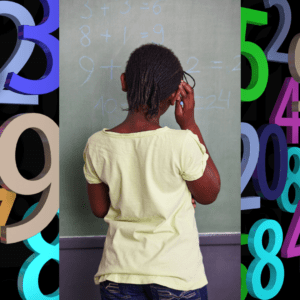
What is Dyscalculia and how can you identify the signs
Dyscalculia is a specific and persistent difficulty in understanding numbers which can lead to a diverse range of difficulties with mathematics.
It will be unexpected in relation to age, level of education and experience and occurs across all ages and abilities.
Dyscalculia is under studied and under resourced in comparison with dyslexia. However, it is estimated that dyscalculia is likely to occur in 3% – 6% of the population, and, unlike some other specific learning difficulties, is as likely to affect females as males.
It can often occur with one or more conditions such as dyslexia, dyspraxia or ADHD/ADD. Although this may be as a result of sharing characteristic factors such as working memory, research is ongoing into the likely interaction between any individual’s cognitive, biological and environmental factors.
Dyscalculia is not the same as maths anxiety, but people with dyscalculia can react strongly to activities involving mathematics, for instance they may get upset or frustrated when playing board games.
Keep in mind that all people can occasionally struggle with maths. Those with dyscalculia will struggle to a greater extent than their peers, and their difficulties will continue over time.
Here are some of the signs to look out for, courtesy of Maths Explained which could help guide conversations with schools or employers;
Pre School
- Has trouble learning to count
- Struggles to connect a number to an object, such as knowing that “3” applies to groups of things like 3 cakes, 3 cars, or 3 friends
- Struggles to recognize patterns, like smallest to largest or tallest to shortest
Primary School
- Has difficulty learning and recalling basic number facts such as number bonds, e.g. 6 + 4 = 10.
- Still uses fingers to count instead of using more advanced strategies (like mental maths)
- Poor understanding of the signs +, -, xx and x or may confuse these mathematical symbols
- Struggles to recognise that 3 + 5 is the same as 5 + 3 or may not be able to solve 3 + 26 ‒ 26 without calculating
- Has trouble with place value, often putting numbers in the wrong column.
- May not understand maths language or be able to devise a plan to solve a maths problem.
- Finds it difficult to understand maths phrases like greater than and less than
- Has trouble keeping score in sports or games
- Has difficulty working out the total cost of items and can run out of money
- May avoid situations that require understanding numbers, like playing games that involve maths.
Secondary School
- Struggles to understand information on charts and graphs.
- Has trouble finding different approaches to the same maths problem, such as adding the length and width of a rectangle and doubling the answer to solve for the perimeter (rather than adding all the sides).
- Struggles to learn and understand reasoning methods and multi-step calculation procedures
- Has trouble measuring items like ingredients in a simple recipe or liquids in a bottle.
- Lacks confidence in activities that require understanding speed, distance and directions, and may get lost easily.
- Has trouble applying maths concepts to money, such as calculating the exact change.
Adults
Typical symptoms include:
- difficulty counting backwards
- difficulty remembering ‘basic’ facts
- slow to perform calculations
- weak mental arithmetic skills
- a poor sense of numbers & estimation
- Difficulty in understanding place value
- Addition is often the default operation
- High levels of mathematics anxiety
Support
Dyslexia.uk have a free helpline 0115 924 6888 which is open,
- Mondays 1:00pm until 5:00pm
- Tuesdays 9:00am until 1:00pm
- Wednesdays 1:00pm until 5:00pm
- Thursdays 9:00am until 1:00pm
- Fridays 9:00am until 1:00pm
- Saturdays & Sundays closed
and can also be contacted via:
- Email: Helpline@dyslexia.uk.net
- Facebook: www.Facebook.com/DyslexiaUK
- Twitter: www.twitter.com/DyslexiaUK
- Instagram: www.instagram.com/dyslexia.uk/
For more information about Dyscalculia and other related learning disabilities click here
I have spent a lifetime struggling with numbers and deciphering graphs and charts etc. I still can’t remember the times tables and struggle with mental arithmetic, especially if I feel under pressure (being observed). I avoid situations where this weakness might be detected and I will be subjected to ridicule or embarrassment. There needs to be wider knowledge, acceptance and understanding of this condition/learning disability. I’m 77 years.